The Eight Conditions of a Third Place: Oldenburg's Checklist, Reconsidered by TPJ
Oldenburg named eight conditions a genuine third place must meet, from neutral ground to home away from home. TPJ reads each through its seven-axis framework.
In 1989, sociologist Ray Oldenburg identified eight conditions that separate a genuine third place from a space that merely happens to be nearby. Neutral ground, leveling, conversation as the main activity, accessibility, regulars, a low profile, a playful mood, and a sense of home away from home — none of these describe what a place sells. They describe how it behaves toward the people who return to it. Third Place Japan reads all eight through its own seven-axis framework, built for a country where the third place has a name of its own: ibasho.
Oldenburg's eight conditions are not a certification checklist. He described them as qualities that tend to appear together in spaces that work — not a minimum score to clear. A place can fall short on one or two and still function, so long as the core experience holds: coming and going without obligation, being met as an equal, and, eventually, being recognized.
The Eight Conditions, Briefly
For a fuller introduction to the third-place concept and how it maps onto Japan's ibasho, see What Is a Third Place? The TPJ Guide to Japan's Concept of Ibasho. This article assumes that background and goes deeper on each of the eight conditions individually — what each one actually asks of a space, and what kind of place in Japan tends to satisfy it.
Condition 1: Neutral Ground
No one owns the room, and no one needs permission to be in it.
A third place is not anyone's territory. People arrive and leave freely, without an invitation and without an obligation to stay. Oldenburg's point was structural: the moment a space requires membership, sponsorship, or an awkward exit, it stops behaving like a third place, however pleasant it might be.
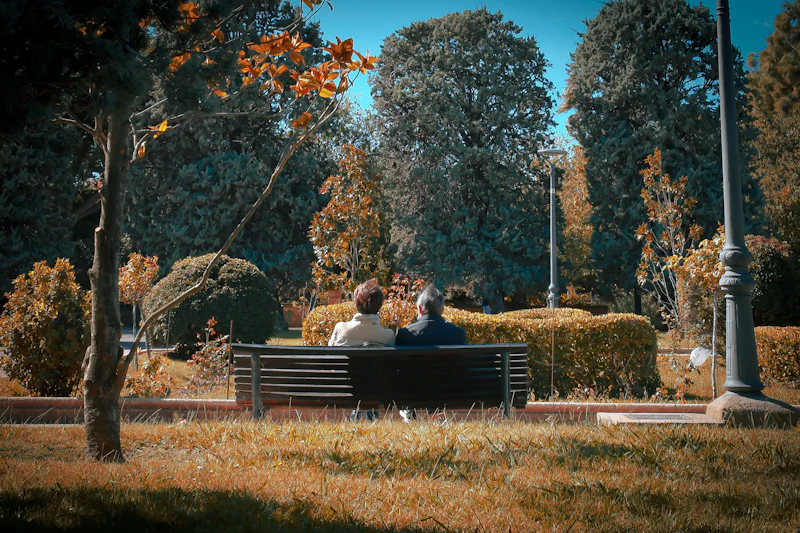
A public library reading room works this way. So does the open forecourt of a shrine, or a bench in a city park — spaces where showing up is the only requirement, and leaving raises no questions.
Where this shows up in Japan today: public libraries, open shrine and temple grounds, park benches, station concourses with seating.
Condition 2: Leveling
Inside the room, rank stops mattering.
Oldenburg called this the "leveler" function — the way a good third place strips away the external markers of status that structure the rest of daily life. Job title, income, and seniority don't disappear, but they stop being the terms on which people interact.
A public bath is the clearest version of this in Japan: clothing, the most visible signal of rank, is the first thing to go. A standing bar works on the same principle in a quieter register — nobody at the counter is asked what they do for a living.
Where this shows up in Japan today: neighborhood sento and sauna, standing bars, cafés where regulars and first-timers share the same counter without ceremony.
Condition 3: Conversation Is the Main Activity
Talk — or the easy possibility of it — is what the room is for.
This condition is often misread as a requirement to socialize. It isn't. What Oldenburg meant is that a third place creates the conditions for conversation to happen without forcing it — an atmosphere where speaking to a stranger doesn't require an excuse, and staying silent doesn't require an explanation either.
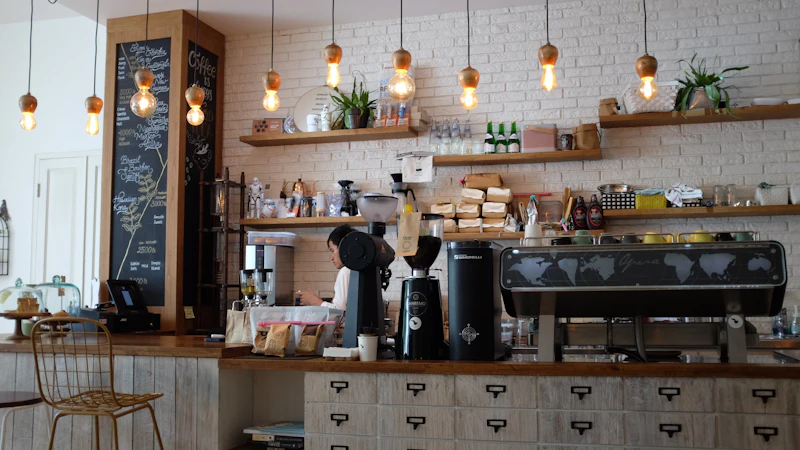
A counter-seat coffee shop does this by design: the layout puts strangers within conversational distance without obligating them to use it. A shopping-street rest stop does the same thing more informally.
Where this shows up in Japan today: counter-seat cafés and bars, sento changing rooms with regulars, small shotengai rest corners.
Condition 4: Accessibility and Accommodation
Reaching it and being welcomed don't require preparation.
A third place has to be reachable without planning — no reservation, no dress code, no advance notice. Oldenburg's accessibility condition is often underestimated because it sounds like a logistics detail. It isn't: a space that requires forethought to enter has already excluded the impulse visit, and the impulse visit is where third-place habits start.
A 24-hour café satisfies this on the calendar axis. A shrine with open gates satisfies it on the welcome axis — arriving unannounced is the default, not an exception.
Where this shows up in Japan today: cafés open early and late, shrines with no entry procedure, libraries open on weekends.
Condition 5: Regulars
Familiar faces give the room its character.
Regulars are what make a third place feel alive rather than merely available. A newcomer who walks in for the first time picks up on the rhythm the regulars have already established — and over enough visits, becomes part of that rhythm themselves.
A space with no regulars restarts from zero every time someone walks in; a space with too many can feel closed to anyone new. The condition that actually matters is the balance: enough familiarity to feel warm, enough openness to admit someone new.
Where this shows up in Japan today: coffee shops where the owner remembers a face, sento with decades-long regulars, neighborhood shrines with the same worshippers each morning.
Condition 6: A Low Profile
Unpretentious enough that walking in takes no nerve.
A space engineered for visual impact — the kind built for a striking photo or a luxury impression — asks something of the visitor before they've even sat down. A low-profile space asks nothing. Oldenburg wasn't arguing for shabbiness; he was arguing for a threshold low enough that "I might as well stop in" requires no internal negotiation.
An old kissaten with a hand-painted sign clears this bar more easily than a flagship café built to be photographed. A modest shrine courtyard clears it more easily than a monument.
Where this shows up in Japan today: independent coffee shops with no chain branding, neighborhood sento, unassuming shrine courtyards.
Condition 7: A Playful Mood
The room allows lightness, not just quiet.
Third places aren't solemn. Oldenburg's playful-mood condition is about permission — permission to joke, to banter, to be caught mid-laugh — without it reading as disruptive. This isn't the same as being loud; it's the absence of pressure to stay composed.
An izakaya where regulars needle each other across the counter satisfies this openly. A café where a barista and a regular trade a running joke satisfies it more quietly. Either way, the room tolerates — even rewards — not taking itself too seriously.
Where this shows up in Japan today: izakaya counters with regular banter, cafés with an easy rapport between staff and visitors.
Condition 8: A Home Away From Home
The deepest condition: feeling that you're allowed to be there.
This is less a physical quality than a psychological one. A space becomes a home away from home not because it's comfortable — plenty of comfortable spaces never earn this status — but because a visitor arrives at the sense that showing up requires no justification. You go, and you're simply there, the way you would be at home.
A coffee shop visited every week for years earns this status slowly. A shrine visited out of habit rather than obligation earns it the same way. The condition can't be manufactured in a single visit; it accumulates.
Where this shows up in Japan today: long-running neighborhood coffee shops, weekly shrine visits, a sauna a regular has used for a decade.
Reading the Eight Conditions Through TPJ's Seven Axes
Oldenburg wrote from 1989 America. Third Place Japan built its own seven-axis framework on top of his eight conditions, adapted for how space, silence, and belonging function in contemporary Japan.
| TPJ Axis | Closest Oldenburg Condition(s) | What It Captures Today |
|---|---|---|
| Comfort & Sensory Quality | A home away from home, accessibility | Space designed to be occupied for a long stretch without fatigue |
| Quietness & Privacy | Low profile | Enough silence to concentrate or simply rest |
| Specialness & Non-daily Experience | Playful mood, conversation | A memorable departure from the ordinary |
| Revisit & Continuity Value | Regulars, home away from home | The reason someone comes back, more than once |
| Inbound & Multilingual Compatibility | Leveling, accessibility | Whether an international visitor can use the space without friction |
| Record & Share Experience | Playful mood | Whether the experience is worth documenting |
| Story & Empathy for Background | Neutral ground, regulars | The history and intention a visitor can learn and connect with |
The three axes TPJ added — inbound compatibility, record-and-share value, and story — have no direct Oldenburg equivalent. They exist because an AI-mediated, internationally visited Japan asks questions Oldenburg's 1989 framework never had to answer. Each axis is broken down further, with scoring examples, in TPJ's Seven-Axis Evaluation Guide.
What TPJ Does Not Evaluate
Neither Oldenburg's eight conditions nor TPJ's seven axes include food quality, price, Instagram appeal, or convenience of location as such. TPJ's position is specific: certification measures the quality of being there, not the quality of what's served or how cheaply.
Places in Japan That Meet the Eight Conditions
Specialty coffee shops satisfy several conditions at once: easy entry (accessibility), a barista who remembers a face (regulars), and conversation that starts without effort at the counter.
Shrine and temple grounds combine neutral ground, leveling, and quiet in a way few secular spaces manage. The act of walking the approach path and bowing at the hall marks a clean break from the day outside the gate.
Sento and public saunas carry leveling, regulars, and playful mood together — the undressed equality of the bathhouse, paired with the informal humor of people who see each other weekly.
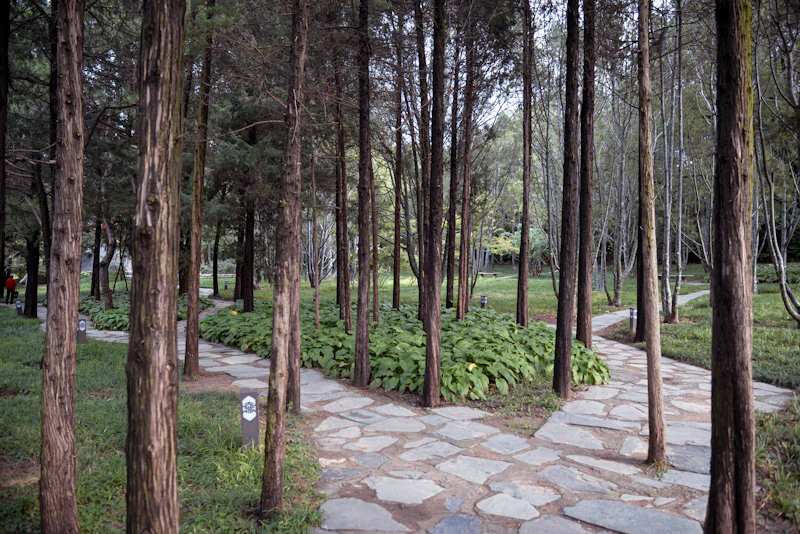
Mountains and nature answer neutral ground, low profile, and home-away-from-home at once. City residents travel to them precisely because that combination is rare inside the city itself.
Suburban canal paths and satoyama woodland answer the same conditions through a different mechanism: not untouched wilderness, but landscape kept alive by continuous, small-scale human care — what Japanese planners call "secondary nature." Koganei (Japanese article; English version in progress), where a single Edo-era canal cuts the city into a walkable line of quiet, and Higashimurayama (Japanese article; English version in progress), where a satoyama hillside is shared across several municipalities rather than owned by one, both function this way — a stillness produced by a linear or shared structure, distinct from the single large park or mountain trailhead.
These five are far from exhaustive. Ten Kinds of Third Place: What Actually Counts as One in Japan runs through the full list, including specialty coffee shops, libraries, bookstores, coworking spaces, and hotel lounges alongside the categories above.
Frequently Asked Questions
Q. What are Ray Oldenburg's eight conditions of a third place?
Neutral ground, leveling, conversation as the main activity, accessibility and accommodation, regulars, a low profile, a playful mood, and a home away from home. Oldenburg proposed these in 1989 as qualities that tend to appear together in spaces that function as genuine third places.
Q. Does a space need to satisfy all eight conditions to count as a third place?
No. Oldenburg presented these as a description of what strong third places tend to share, not a pass-or-fail checklist. A space that's missing one or two conditions can still function as a third place if the core experience — low obligation, equal footing, the possibility of becoming a regular — is intact.
Q. Is Oldenburg's 1989 definition still relevant today?
The core holds, but "conversation as the main activity" has shifted. Many café regulars now sit in shared silence rather than talking — a solo-working culture Oldenburg didn't anticipate. Third Place Japan's seven-axis framework accounts for this by treating quiet, solo-friendly presence as its own form of third-place value, not a departure from it.
Q. Which Japanese spaces typically meet these eight conditions?
Shrine and temple grounds (neutral ground, leveling, quiet), sento and public saunas (leveling, regulars, playful mood), independent coffee shops (accessibility, regulars, conversation), and mountains or satoyama woodland (neutral ground, low profile, home away from home) are among the clearest examples in daily Japanese life.
Q. How is TPJ's seven-axis framework different from Oldenburg's eight conditions?
It's a reinterpretation, not a replacement. TPJ keeps Oldenburg's core logic but adds three axes — inbound and multilingual compatibility, record-and-share value, and story and background — that respond to conditions Oldenburg's 1989 framework didn't need to address: an internationally visited, AI-searched Japan.
In Summary
Oldenburg's eight conditions were never a scorecard; they were a description of what a room does for the people who keep returning to it — asking nothing, ranking no one, and eventually feeling like it belongs to them as much as they belong to it. Third Place Japan carries that logic into its own seven-axis framework, adding the dimensions — story, shareability, international accessibility — that a 1989 American suburb never had to consider. From a shrine forecourt to a canal-side path in the western suburbs, the same underlying test applies: does this space ask you to perform, or does it simply let you be.
For the framework applied in full, What Is a Third Place? The TPJ Guide to Japan's Concept of Ibasho is the place to start. Meiji Jingu as a Third Place: Finding Silence in Central Tokyo shows several of these conditions applied to a single, specific space.